The Digital Pragmatism: Why Digital Agricultural Knowledge Platforms are the Real Future of Indian Agriculture
- September 24, 2025
- Posted by: Naveen Kumar V
- Category: Insights
The Digital Pragmatism: Why Digital Agricultural Knowledge Platforms are the Real Future of Indian Agriculture
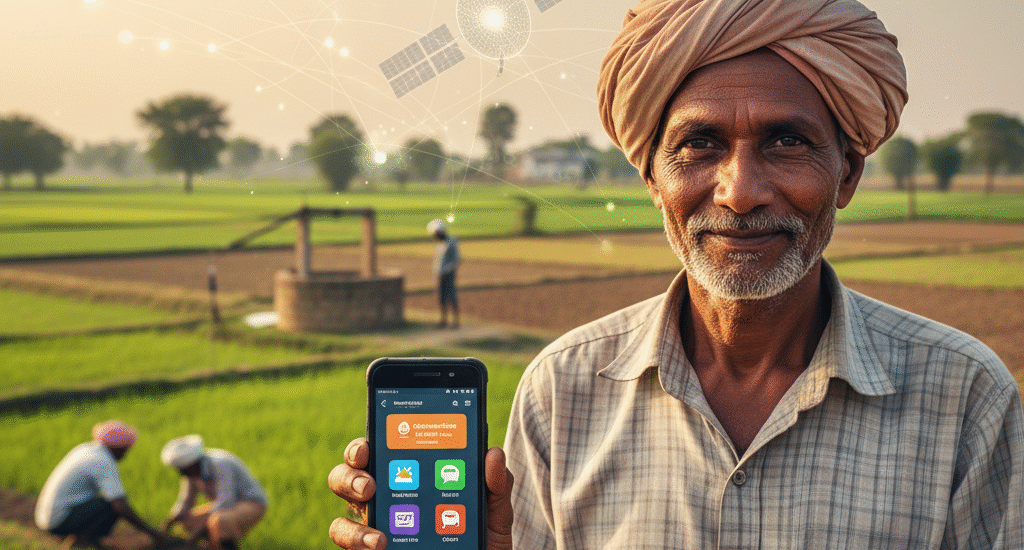
The narrative of agricultural revolution in India is frequently centered on high-cost investments drones, complex sensors, and sophisticated Machine Learning (ML) models demanding massive capital. Yet, this focus on robust, high-investment solutions fundamentally misaligns with the reality of India’s 86% small and marginal farmers, whose average landholding is often just 0.38 hectares. Lets explore Digital Agricultural Knowledge platforms here.
This article argues that the true path to widespread farmer empowerment lies not in complex, high-cost technologies, but in the scalable, low-cost delivery of Digital Agricultural Knowledge (DAK) platforms, which offer high service at minimal expense, making them the economically and practically superior alternative.
1. The Low-Cost Alternative: Digital Agricultural Knowledge
Digital Agricultural Knowledge platforms prioritize delivering timely, localized, and actionable information over developing proprietary, expensive hardware and data analytics. Their success hinges on accessibility, high penetration, and economic fitness.
Digital Agricultural Knowledge platforms operate on a model built for the smallholder: they leverage existing low-cost infrastructure—the farmer’s own basic smartphone and basic mobile internet—to deliver essential information. This contrast sharply with high-investment models:
High-Investment AI/ML |
Low-Cost Digital Agricultural Knowledge Platforms |
| Input Requirement: Expensive IoT sensors, Drones, Satellite Imagery. | Input Requirement: Farmer-submitted queries (text/voice), public domain weather data, Krishi Vigyan Kendra (KVK) advisories, existing market data. |
| Digital Literacy Need: High; requires navigation of complex dashboards and devices. | Digital Literacy Need: Low; often utilizes vernacular languages, voice search, and simple alerts (SMS/App notifications). |
| Cost to Farmer: High initial capital investment, recurring subscription fees. | Cost to Farmer: Minimal or Free (App download and basic internet usage). |
| Economic Fit: Suitable for large-scale, monoculture corporate farms. | Economic Fit: Highly Scalable and Affordable for the typical 0.38-hectare smallholder. |
2. High Service, Low Investment: The DAK Impact
These platforms prove that high-impact service can be delivered without high cost, thereby building financial resilience directly into the agricultural ecosystem:
- Real-time Market Access: Digital Agricultural Knowledge platforms provide daily mandi market prices and price trends for numerous commodities. This readily accessible information empowers farmers to bypass exploitative middlemen, negotiate better sales, and time their post-harvest activities effectively. This single service significantly enhances profitability without requiring any on-farm capital expenditure.
- Pragmatic ML Integration (AI-Lite): Instead of using ML for high-cost tasks like real-time yield mapping, DAK platforms apply it to knowledge dissemination. ML algorithms efficiently process, categorize, and match farmer queries (often submitted via voice or text) with a vast database of localized, expert-validated crop management techniques, pest diagnosis, and remedy recommendations. This is Machine Learning applied to knowledge, making it practical and reliable for current conditions.
- Improved Reliability and Practicability: The information provided—such as localized weather alerts, pest/disease advisories, and fertilizer optimization tips—is highly actionable and directly contributes to a reduction in crop expenditure and an increase in productivity. Since the advice is often localized and based on data relevant to the farmer’s region, the reliability is higher than generalized, high-tech models.
- Enhanced Accessibility: By prioritizing delivery in vernacular languages and optimizing content for low-bandwidth environments, DAK platforms achieve far higher penetration among older farmers and those in remote areas, bridging the information gap that traditional extension services often fail to cross.
3. Policy Implications: Prioritizing Scalable Digital Agricultural Knowledge
The failure of high-cost solutions often stems from their dependency on high-quality, continuous data from tiny, fragmented plots—a challenge ML struggles with (Data Scarcity for Micro-Plots). The DAK model sidesteps this by focusing on low-tech data collection and high-tech knowledge delivery.
To truly revolutionize Indian agriculture, policy must re-prioritize funding away from expensive, aspirational projects and towards scalable DAK infrastructure:
- Fund Digital Outreach, Not Just Hardware: Government support should focus on subsidizing the development, localization, and promotion of DAK platforms, ensuring content is available in all vernacular languages and via simple formats (SMS/voice).
- Hybrid Solutions as Standard: Mandate the seamless integration of traditional Krishi Vigyan Kendra (KVK) expertise with DAK platforms, ensuring the information delivered is not only technically precise but trusted and locally validated, building upon farmer experience.
- Data for Public Good: Invest in localized, granular data collection methods to feed simple, context-specific ML models that underpin DAK platform services, ensuring the benefit of data collection is immediately returned to the farmer via low-cost, practical information.
The economic and logistical argument is clear: the most impactful digital agriculture strategy for India is one built on low cost, high service, and pragmatic technology. Empowering the small farmer is achieved by delivering the right knowledge at the right time, making high-tech dreams irrelevant when compared to the tangible, low-cost reality of DAK.